Your finishing line failed a VOC inspection — or it’s close enough to the limit that you know the next one is coming. Emissions of volatile organic compounds are regulated by the U.S. EPA, so staying within parameters isn’t optional, and the question in front of you is a hard one: what are our options for a finishing line that actually meets VOC limits — without gutting our throughput or our finish quality?
The most direct answer is also the one GAT has already delivered for a real manufacturer facing exactly this: replace or convert the wet paint line to powder coating. This page walks through why that removes the VOC problem at the source, what the conversion looks like, and the documented Tracker Marine project — with the real line GAT engineered and the compliance result.
Why powder coating removes the VOC problem at the source
A wet paint line emits VOCs because liquid paint contains them: solvents and volatile organic compounds that evaporate into the air as the coating flashes off and cures. That evaporation is the emission — it’s inherent to the chemistry, which is why an aging wet line eventually runs into the regulatory ceiling no matter how you tune it.
Powder coating is a different mechanism. The powder contains no solvents and no VOCs — there are no fluids in it that can evaporate — so it doesn’t pose the same emissions problem as traditional liquid paint. Converting a wet line to powder doesn’t reduce the VOC source; it removes it. (Powder brings other operating advantages too — see why powder coating beats liquid painting and the full conversion guide.)
What a compliant conversion actually looks like
Getting compliant isn’t buying a booth off a shelf — it’s engineering a line around your parts, your throughput, and your chemistry. GAT is a single-source finishing partner: the same people who quote the line design it, build it, install it, and start it up (the GAT process). A wet-to-powder conversion typically means a pretreatment washer, a dry-off oven, one or more powder coating rooms with reclaim, and a cure oven — sized to your parts, not a catalog SKU.
A forced VOC replacement is also the moment to fix everything else that the old wet line did poorly. The manufacturers who come out ahead treat compliance as the trigger, not the whole scope: same project, better throughput, better finish, lower reject rate. That’s exactly the path the Tracker Marine project took.
Proof: Tracker Marine — a wet line replaced because it hit VOC limits
Tracker Marine, an OEM boat manufacturer in Lebanon, MO, needed to replace an antiquated wet paint line because it had reached VOC limitations. Because they were already committed to the investment, they used it to also improve the line’s operating performance and finish quality and to reduce the wet-line post-paint reject rate and per-unit cost.
After a year of process development, GAT engineered a line that applies three separate colors of powder to the same boat, with masking and gel between colors and before final cure. The system: a three-stage aqueous pretreatment washer, a convection dry-off oven, three separate hybrid gel processes, three powder booths in a single large powder room, a final convection cure, and a custom power-and-free conveyor with a specialized load-bar configuration — handling boats up to 8’W × 5’D × 26’L and 2,000 lbs.
The compliance result, in the customer record’s own terms: Tracker Marine is now well within state and federal limits for VOCs — and better equipped to increase production than it was on the line it replaced.
Read the full Tracker Marine story → — or watch the line in action, with full transcript and chapters. This is also one of three documented projects in Modernize or Expand Your Finishing Line.
Get Started
If your line has hit a VOC limit — or is about to — the first step is a free, no-obligation consultation: bring your parts, your current process, and the limit you’re up against, and GAT will lay out the compliant path. Basic part dimensions and weight are enough to start the conversation.
Common questions
Does switching to powder coating actually solve a VOC problem?
Can GAT convert our existing wet paint line to powder?
Will a compliant line hurt our finish quality or throughput?
Can a powder line handle multi-color parts?
How long does a custom compliant line take to build?
Related Reading
Tracker Marine: Replacing a Wet Line That Hit VOC Limits
The documented VOC-driven replacement — an antiquated wet paint line swapped for a three-color powder system.
READ MORE »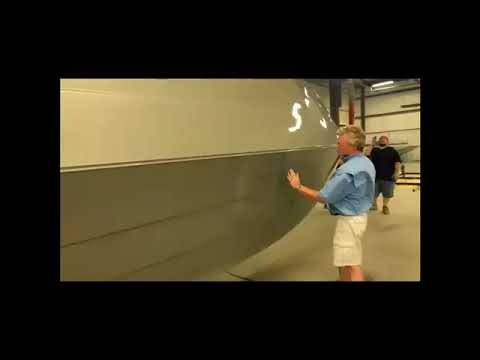
Tracker Marine Video: Powder Coat Line in Action
Watch the line GAT engineered for Tracker Marine's replacement project, with full transcript and chapters.
READ MORE »The Guide to Converting from Liquid Paint to Powder Coating
Why powder contains no solvents or VOCs, and what a conversion involves end to end.
READ MORE »