Our finishing line is the bottleneck — but we don’t know if it’s the oven, the conveyor, or something upstream. Whatever it is, we can’t hit our takt time, and we don’t want to rebuild the whole line to fix it.
That’s a diagnostic question, not a product question — the fix could be the oven, the conveyor, or a layout problem, and most engineers guess wrong on which one. Here’s how to find the real bottleneck, and a real, documented 40% cycle-time gain from fixing the right one.
Finding the Real Bottleneck
When a paint or powder-coat line can’t hit daily quota, most engineers look first at the oven — sometimes correctly, sometimes not. GAT’s own case studies point to three places the bottleneck actually hides:
- The oven’s ramp rate. A faster ramp rate lets you run a shorter oven for the same cure — and a shorter oven usually means a faster line. Direct-impingement ovens close this gap fastest (see below).
- Conveyor layout, not conveyor speed. A few inches of chain sag, an undersized drive, or a poor curve radius can throttle feet-per-minute long before the oven or booth becomes the limit.
- Batch vs. continuous processing. If a batch oven takes 7.5 minutes to process 6 parts (including loading and unloading), a continuous oven — even with the same processing time per part — can handle around 45 parts in that same 7.5-minute window. The difference is idle load/unload time, not cure chemistry.
The 40% Cycle-Time Gain: Direct-Impingement Ovens
When the oven genuinely is the bottleneck, GAT’s own documented case study shows what fixing it looks like: switching to direct-impingement ovens — which blast heated air directly onto the part surface from high-velocity jets, instead of just circulating it — cut cycle time by 40% without a full line rebuild.
The real numbers behind that gain:
- High line speeds: direct-impingement keeps up at line speeds over 75 feet per minute, where standard convection starts to struggle.
- ±5°F temperature uniformity across the belt, even at that speed — which also reduces color shift on mixed-metal loads curing at different rates.
- ~15% gas savings from patented Air-Seal vestibules, which keep heat inside the oven instead of leaking it into the aisle.
- Shorter oven footprint for the same cure, because the direct blast heats faster than circulated air.
Read the full 40% cycle-time case study →
Engineering to Your Takt Time, Not a Catalog Spec
GAT’s own framing for this is direct: “When off-the-shelf equipment can’t hit your takt time or quality spec, GAT designs fully custom finishing lines — from pretreatment washers to curing ovens and conveyors — all fabricated and programmed under one roof in Fenton, Missouri.”
That shows up in the hardware itself. GAT’s Process Ovens run conveyor speeds up to 90 fpm with a powder cure of 12 minutes or less at 400°F using hybrid IR boost zones. GAT’s Conveyors hold ±1 fpm speed repeatability with VFD drives — smart PLC control that syncs takt time and reduces work-in-progress, whether the line is overhead track, power-and-free, or I-Beam, from 200 lb enclosed-track loads up to 6,000 lb per carrier.
Conveyor Layout: the Silent Speed-Killer
It’s easy to blame the oven or the booth when a line can’t hit quota — but the overhead conveyor layout is often the real culprit. A few inches of chain sag, a mis-sized drive, or a poor curve radius can rob a line of feet-per-minute before anything downstream even becomes the bottleneck.
GAT’s own guide to this walks through the five most common layout mistakes — under- or over-specifying track capacity, drive sizing, and curve radius among them — drawing on data from GAT’s own conveyor portfolio, from 200-lb enclosed track to 6,000-lb I-Beam and power-and-free drives.
Read the full conveyor layout guide → — note: this post is queued for a data refresh with more quantified before/after layout figures; the mistakes it documents are real GAT engineering guidance today.
Proof: A Real 300% Throughput Gain
Santa Rosa Systems (SRS), a Louisville, KY manufacturer of conveyor and material-handling systems, needed a new powder coating line to keep up with rising customer demand — without sacrificing finish quality or supply-chain reliability.
GAT built a custom automated three-stage line: an aqueous pretreatment washer, a convection dry-off oven, an automated powder booth with reclaim capability, and a convection cure oven — handling parts up to 5’W × 5’H × 26’L and 5,000 lbs. In SRS’s own words:
“The new line has given us the ability to blow our old system’s throughput out of the water. Every day, we paint the equivalent of 6 to 7 daily shifts worth of parts compared to our old powder paint system thanks to the line that we designed with GAT.” — Santa Rosa Systems
Throughput improved 300% against the old system.
Read the full Santa Rosa Systems story →
Get Started
Every bottleneck has a real cause, not a guess. GAT’s consultation is free, with no obligation.
How long can a GAT oven run without maintenance affecting throughput?
Can I upgrade a legacy conveyor with power-and-free sections instead of replacing it?
How often does the conveyor chain need lubrication?
How often do powder booth filters need changing?
Related Reading
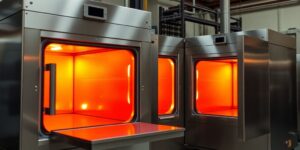
Can't Hit Your Line's Takt Time? A 40% Cycle-Time Gain with Direct-Impingement Ovens
The full case study: how switching to direct-impingement ovens cut cycle time 40% without a line rebuild.
READ MORE »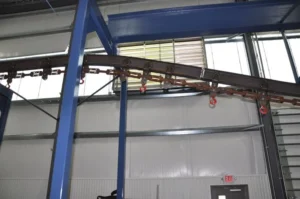
Overhead Conveyor Systems: 5 Layout Mistakes That Kill Line Speed
Track capacity, drive sizing, and curve radius: the layout mistakes that throttle a finishing line's feet-per-minute.
READ MORE »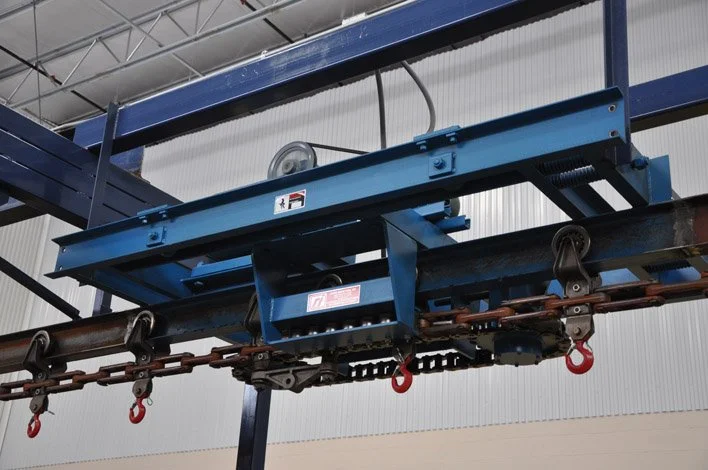
Santa Rosa Systems: 300% Throughput Gain
How a GAT-designed three-stage powder line let Santa Rosa Systems paint 6 to 7 shifts' worth of parts per day, compared to their old system.
READ MORE »